Roof Battening
Category: Battens & Underlay
Tags: roof battens, batten spacing, roofing basics, slate roofing, tile roofing
What You’ll Learn
This guide explains everything you need to install roof battens correctly, including:
- What battens are and what they do
- The correct batten sizes and grades
- How to measure and mark batten spacing
- Tools you’ll need
- Step-by-step instructions
- Common mistakes to avoid
- Professional roofer tips
- FAQ
What Are Roof Battens?
Roof battens are horizontal timber strips fixed to rafters. They:
- Support roof tiles or slates
- Keep rows straight and evenly spaced
- Provide fixing points for tiles/slates
- Strengthen and stabilise the roof structure
In the UK, the most common sizes are:
- 25×38mm (standard tile battens)
- 25×50mm (heavy-duty or windy areas)
Battens must be graded timber, stamped with BS5534.
Tools You’ll Need
Basic Tools
- Tape measure
- Roofing square
- Chalk line / string line
- Pencil or marker
- Hammer or nail gun
- Spirit level
Optional
- Laser line
- Batten gauge
- Clout nails or ring shank nails
- PPE: gloves, boots, eye protection
How to Calculate Batten Spacing
Batten spacing depends on the type of roofing material.
For tiles (concrete or clay):
- Check the tile manufacturer’s spec
- Find:
- Headlap
- Gauge
- Measure two tiles together and confirm the working gauge
- Typical tile gauge: 75–345mm depending on tile type
For natural slate:
Use standard gauges:
- 500×250 slate → 100mm headlap → gauge ~ 250mm
- 400×250 slate → 90mm headlap → gauge ~ 200mm
Rule: the smaller the slate, the smaller the gauge.
Step-by-Step: How to Lay Roof Battens
1. Fit Your Underlay First
- Lay felt/underlay horizontally
- Overlap the layers by 100–150mm
- Nail at rafters, not between them
- Keep it smooth, no sagging
2. Mark Your Gauge
You need two key lines:Eaves batten position
- Measure up from fascia
- Allow for tile overhang
- Mark a straight line with a chalk line
- Gauge marks up the roof
- Use your tape and square
- Mark every gauge up both rafter sides
- Snap chalk lines across for accuracy
Start Fixing Battens
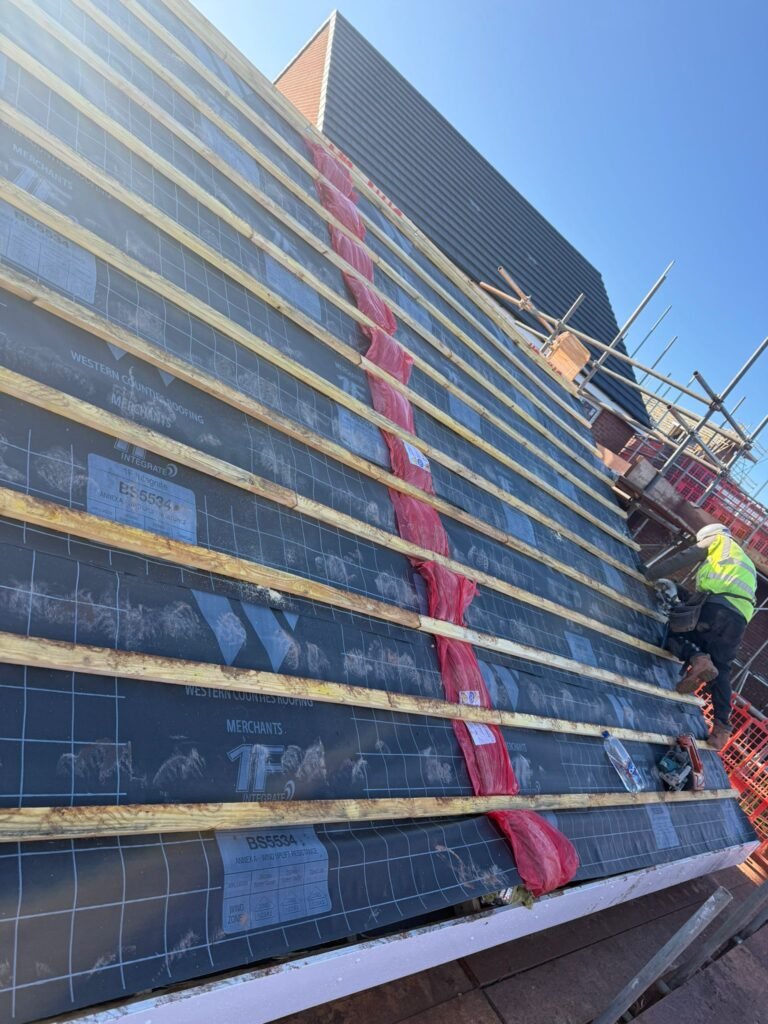
- Use graded BS5534 stamped battens
- Lay them across rafters, follow your chalk lines
- Nail with 2 nails per crossing
- Keep battens dead level
Keep Your Lines Straight
- Use a string line across each row
- Adjust battens if they drift
- Check your gauge regularly
- Don’t trust just your eye — small errors grow fast
Common Mistakes to Avoid
🚫 Not using graded timber — this fails building control
🚫 Wrong gauge — tiles won’t sit correctly
🚫 Running battens uphill/downhill
🚫 Too few nails
🚫 Battens touching the felt (should be above)
🚫 Not leaving room for ventilation at ridge/eaves
Pro Roofer Tips
Use a batten gauge tool — it speeds up spacing dramatically
Pre-mark all gauges before nailing anything
Keep battens 5mm apart where they join (expansion gap)
If a rafter dips or rises, pack battens to keep lines straight
Always check manufacturer gauge for tiles — don’t guess
For slate, use slate gauges + consistent head lap
FAQ
What size battens should I use?
For most roofing: 25×38mm.
For high wind zones: 25×50mm.
Can I use ungraded timber?
No. Building regulations require BS5534 graded battens.
How do I stop battens from twisting?
Store them flat and fix them quickly. Keep battens spaced 5mm at joints.
How do I check my gauge?
Measure 2 tiles together on the ground → find working gauge → transfer up the roof.
Pingback: How to Felt a Roof - rooflogicinc.co.uk
Pingback: How to Measure Batten Gauge for Roof Tiles - rooflogicinc.co.uk
Pingback: How to Install a Dry Ridge System (Beginner-Friendly UK Guide) - rooflogicinc.co.uk
Pingback: How to Install Roof Battens in a Valley (Beginner-Friendly Guide) - rooflogicinc.co.uk
Pingback: Roof Batten Spacing for Concrete & Clay Tiles (UK Guide) - rooflogicinc.co.uk