Roof valleys are one of the most critical areas of any roof. If valley battens are not installed accurately, water can track sideways, tiles won’t sit correctly, and leaks are far more likely to occur.
This beginner-friendly guide explains how to install roof battens in a valley step-by-step, including spacing rules, fixing methods, and common mistakes to avoid.
Safety Warning
Valley work concentrates water flow and often involves awkward footing. Always use secure access equipment and avoid working in wet or icy conditions.
1. What Is a Roof Valley?
A roof valley is where two roof slopes meet, forming a channel that directs rainwater down towards the gutter.
Because valleys carry the highest volume of water on a roof, batten installation must be precise and consistent.
Because valleys take the highest amount of water, the batten work must be:
- Straight and accurately aligned
- Evenly spaced according to the tile gauge
- Cut correctly
- Securely fixed to prevent movement
2. Tools You’ll Need
- Tape measure
- Chalk line
- Pencil/marker
- Hammer or nail gun
- Tin snips / saw for cutting battens
- PPE (gloves & goggles)
3. Basic Rules for Valley Battens
Every roofer must follow these:
1. No batten should ever cross over the valley board
Each batten must stop at the valley line and be cut neatly.
2. Leave a 5–10mm gap between the batten end and the valley board
Prevents moisture wicking.
3. Keep the gauge EXACT
The battens around the valley must match the rest of the roof.
4. Battens on both sides MUST line up
If one side drifts, the tiles won’t sit right.
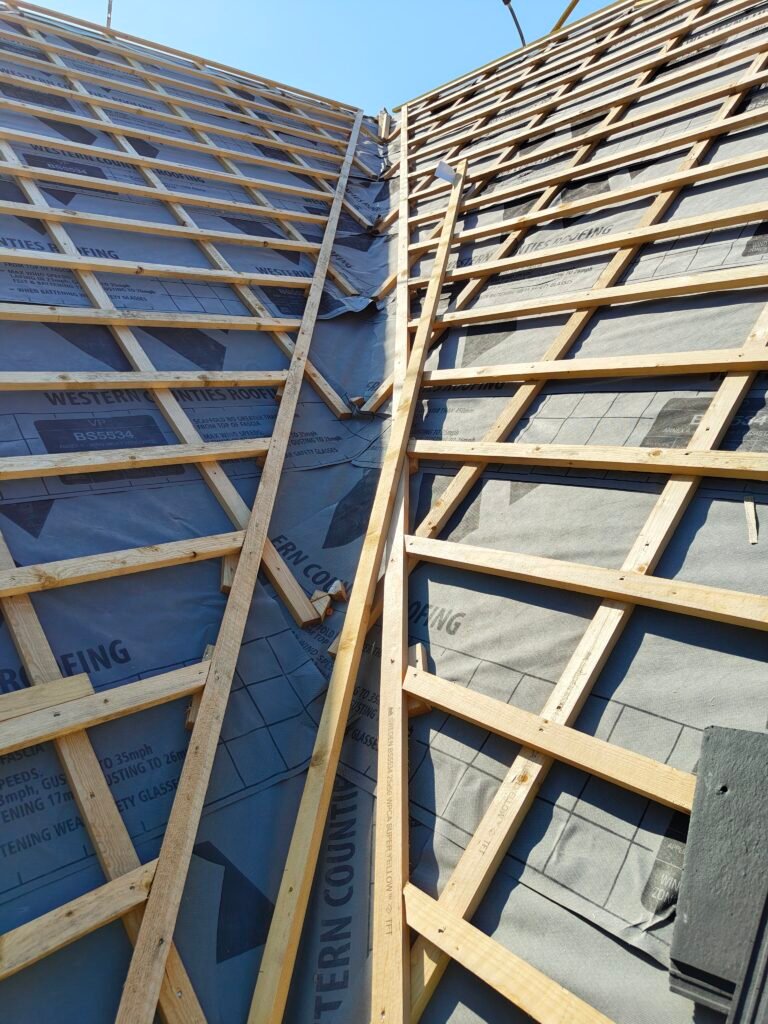
This is a Roof Valley showing counter-battens and correct batten spacing around the valley line. We did this at Dawlish for a Kier Site. The little battens are so supporting the valley on weak spots where the counter batten and valley don’t meet.
4. Step-by-Step: How to Install Battens in a Valley
Step 1 — Install the Underlay First
The underlay should extend INTO the valley, usually:
- 150mm overlap minimum
- Tight and wrinkle-free
- No gaps where water can escape
When you Felt a Roof valley should make sure that you don’t tack it to tight, this will make it harder to find the middle of the valley.
Step 2 — Snap Your Gauge Lines
Before fixing any battens:
- Mark your gauge on both sides of the valley
- Snap chalk lines across the rafters
- Make sure gauges match exactly left and right
Sometimes the Valley will be different depending on what tile or slate you would be using.
Step 3 — Start Fixing Battens Away from the Valley
Begin with the full-length battens further away from the valley.
This keeps your gauge accurate before cutting into the valley section. How to Lay Roof Battens Correctly (Spacing, Rules & Best Practices)
Step 4 — Cut Battens to the Valley Line
Each batten should:
- Be cut perfectly along the valley angle
- Sit 5–10mm back from the valley board
- Follow the gauge line precisely
Your valley photo shows this PERFECTLY — use it here.
It shows the mitred batten ends and spacing.
We usually have the batten go across the valley uncut, we would cut the batten into the Valley. Sometimes there wont be a rafter to nail into sometimes you would nail it at an angle into the Valley batten, this makes it more secure and also less bouncy when slating or tiling.
Step 5 — Check Straightness with a String Line
Even small errors show in a valley.
Use a string line to ensure battens:
- Are not drifting uphill/downhill
- Line up perfectly across the roof
- Maintain the correct gauge
Step 6 — Support the Valley with Proper Boards
Valley boards should be:
- Straight
- Secure
- Wide enough for the valley system (lead, GRP, or dry valley)
Poor valley boards = poor valley finish.
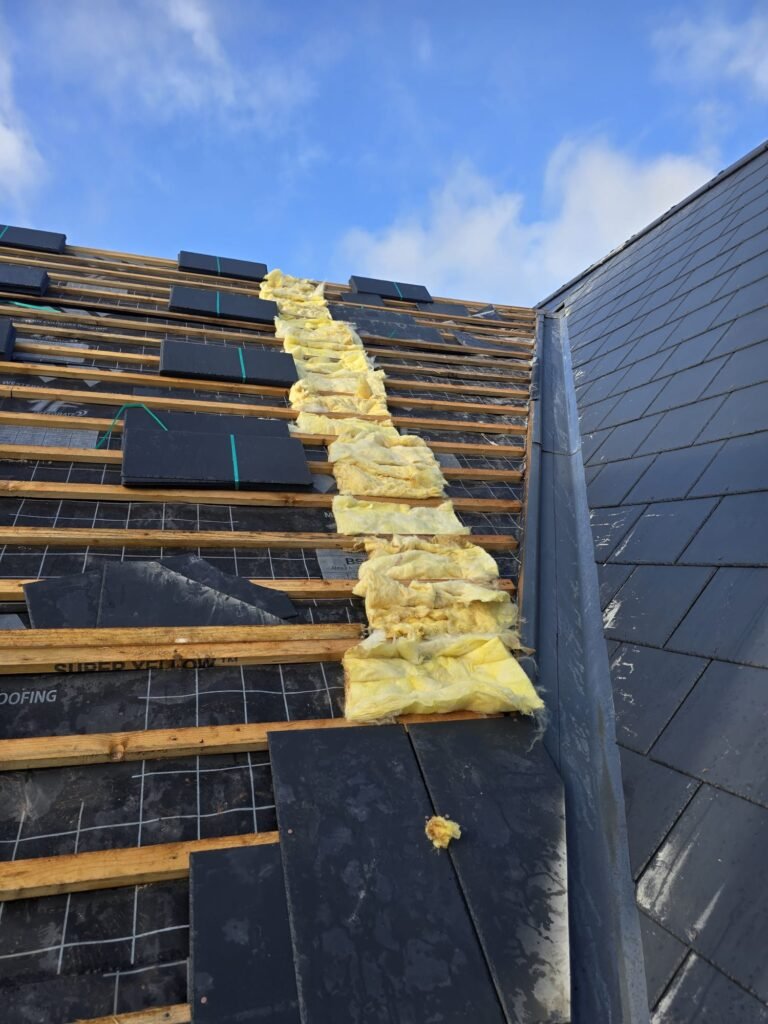
Roof Valley with battens cut to the valley angle and insulation packed down the valley for new build fire safety.
My Experience: On new builds, we often pack insulation down the valley like this to help slow fire spread to other houses. It also reduces wind noise ones the Man-Made Slates are laid. You don’t have to do this on every job, but on new builds this standard.
5. Common Mistakes Beginners Make
Battens running too far into the valley
Battens not cut straight
Gauge drifting as it approaches the valley
Battens touching the valley board (moisture wicks)
Forgetting the 5–10mm gap
Uneven mitre cuts
6. Pro Roofer Tips
- Use a template piece of timber to get your valley angle perfect.
- Double-check gauge every 3 battens on both sides.
- If the roof dips near the valley, pack battens to keep the lines straight.
- Mark valley lines using a chalk line before cutting anything.
- Take your time — a clean valley makes the whole roof look good.
7. FAQ
How much should battens gap from the valley?
5–10mm is standard to prevent water wicking.
Should battens cross the valley?
Never. Battens must stop before the valley channel.
Do both sides of the valley need the same gauge?
Yes — otherwise the tiles won’t line up across the valley.
Can beginners do valley battening?
Yes, if they follow chalk lines, check gauge, and take their time.
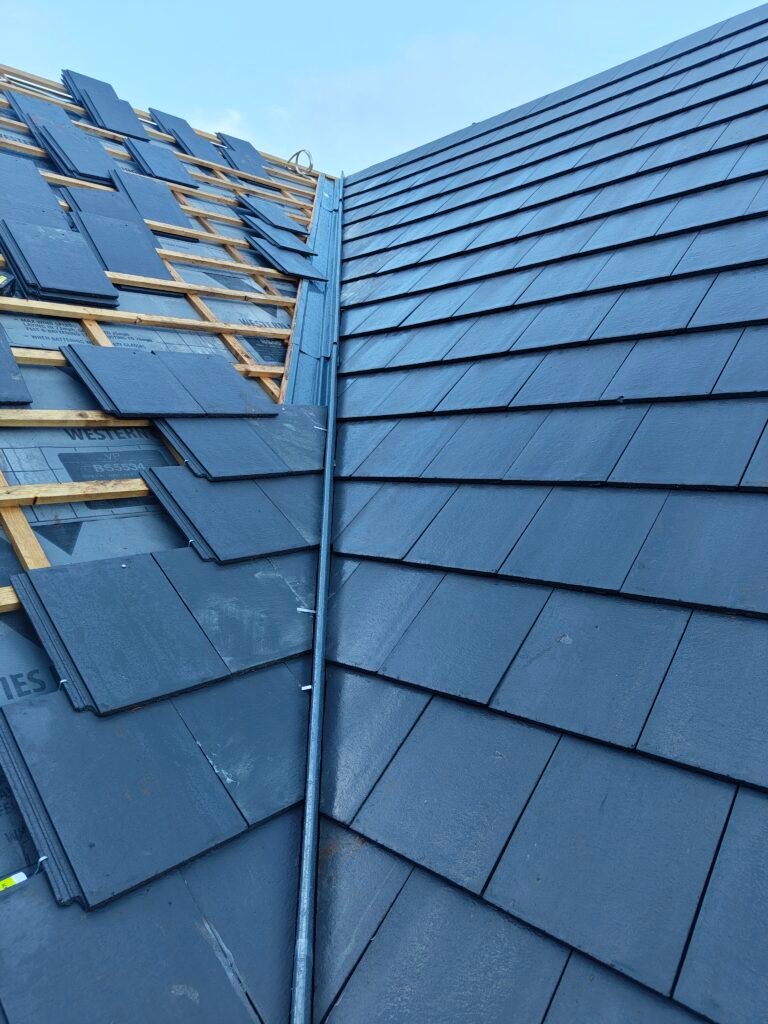
Here’s a Valley with interlocking tiles on. If your battens are lined up properly, the tiles lines should flow cleanly into the valley like this. It makes the whole job look neater and saves a lot of time when fixing cuts. Also if you have to walk on the roof for any reason make sure walk away from the cuts, last thing you want is a broken valley cut.
Pingback: How to Prepare Your Roof for Winter - rooflogicinc.co.uk
Pingback: How Often Should You Check Your Roof? - rooflogicinc.co.uk
Pingback: Why Roof Tiles Slip (And How to Stop It Happening Again) - rooflogicinc.co.uk
Pingback: Do Roof Battens Need Treating? (What We Actually Use on Site) - rooflogicinc.co.uk
Pingback: Roof Batten Spacing for Concrete & Clay Tiles (UK Guide) - rooflogicinc.co.uk